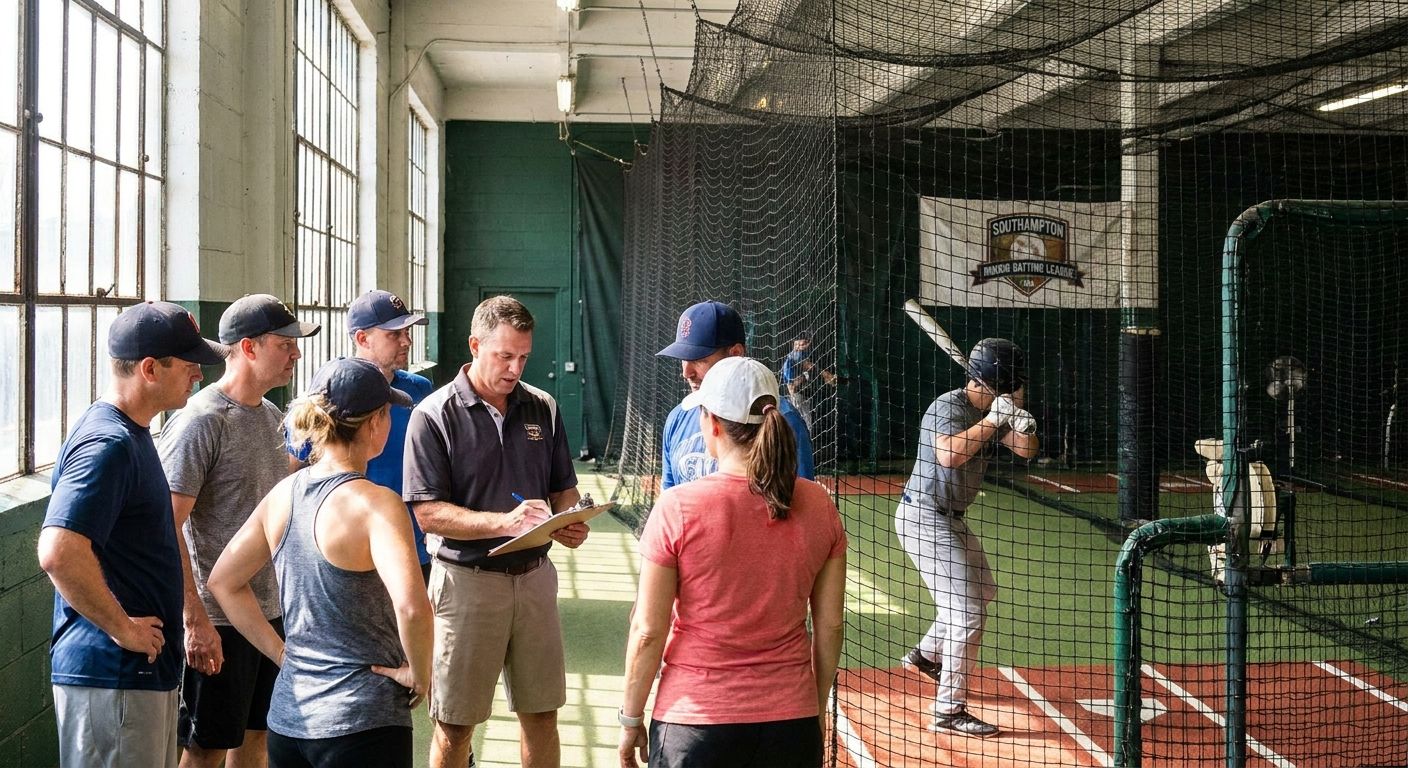
Running a batting league inside an indoor cage takes more planning than a one-off birthday session, but the format is simpler than most people think once you lock in a recurring slot and a scoring sheet. This guide walks through setting up a batting league at 1st Base in Southampton city centre, from team size to season length to keeping people coming back week after week.
- A 6-8 week batting league southampton format works best with 4-8 teams of 4-6 players each — book it.
- Lock a recurring weekly slot at 1st Base before recruiting teams; cage availability disappears fast on weekends.
- Score on total pitches faced rather than innings — it keeps mixed-ability teams competitive.
- Run week one as an unscored trial to fix scheduling and scoring issues before points are on the line.
Why this matters
A one-off batting cage session is a fun night out. A league turns the same cage into a reason people show up every week for two months straight, which is exactly what corporate social clubs, pub teams and stag-do regulars in Southampton have started asking 1st Base for in 2026.
The activity bar model works because a batting cage doesn't need a full diamond, a pitcher, or nine players a side to run a proper competition. Four to six people per team, a scoring sheet, and a recurring booking slot is enough structure to run a real league.
What you'll need
- A recurring weekly time slot — same day, same hour, every week for the season
- 4-8 teams of 4-6 players — smaller than a Little League roster, big enough for rotation
- A season length — 6-8 weeks works well before people lose interest
- A simple scoring system — total pitches faced or hits landed, tracked on a shared sheet
- A batting cage session booked at 1st Base for the kickoff week — confirm the bay before you announce anything to teams
- A tiebreaker rule — decide this before week one, not in week six when it matters
The steps
1. Set your league format and team size
Decide upfront whether this is a 4-team round robin or an 8-team bracket, because the format decides how many weeks you need. Four teams playing each other once needs three match weeks; eight teams round robin needs seven. Most first-time organisers in Southampton start with 4-6 teams — enough competition without a season that drags into month three.
Common mistake: picking too many teams for the cage time available. A single bay realistically handles 2-3 matches per hour slot, so more teams means either longer nights or fewer weeks per matchup.
2. Lock in a recurring weekly slot
Call or book the same evening every week — Tuesday nights and Sunday afternoons tend to have the most consistent availability at an indoor batting cage in the city centre. Read how to book a batting cage session in Southampton before you commit to a season-long block, since group bookings and single sessions are handled differently.
Confirm the slot in writing for the full 6-8 week run before you tell a single team member the league exists. Nothing kills momentum faster than moving week 3 because the cage got double-booked.
Common mistake: announcing the league before the venue slot is locked for the full season, not just week one.
3. Set season length and scoring system
Six to eight weeks is the sweet spot — long enough to feel like a season, short enough that nobody drops out from fatigue. Score on total pitches faced with clean contact, not innings, since batting cages don't have fielders to record outs.
A simple points system: 1 point per clean hit, bonus point for a home-run-zone hit if the cage tracks distance zones, and a match win worth 3 points on the table. Keep the sheet on a single page — a spreadsheet nobody checks is worse than a paper scoresheet everyone can read.
4. Recruit teams and set entry structure
Work colleagues, five-a-side football teams and regular pub groups convert well into batting league teams because the social structure already exists. Southampton has a strong corporate social calendar, and a batting league southampton format slots into that easily as a Tuesday-after-work fixture.
Set a flat per-person cost per season rather than per-week payments — it removes the awkward chasing and locks people in for the full run. Confirm numbers with each team captain a week before kickoff, not the day of.
5. Build a simple standings and rules sheet
One page, one league. List teams, points, and matches played, and pin the tiebreaker rule (usually total clean hits across the season) at the top. Share it in whatever group chat the teams already use — WhatsApp works fine, nobody needs a league app for an 8-team season.
Common mistake: changing the scoring rules mid-season because one team complains. Set the rules in week one and hold them for the full 2026 season.
6. Run week one as a trial
Treat the first week as unscored practice for the format itself. First-timers at a batting cage need a warm-up round before competitive pressure, and this is also when you'll catch scheduling gaps, unclear rules, or a scoring sheet that's confusing in practice. Check how to prepare for your first batting cage session in Southampton and share it with any new players before kickoff.
Expected outcome: by the end of week one you'll know whether the hour-long slot fits 3 matches or only 2, and you can adjust the season schedule accordingly.
7. Keep the league social with off-cage games
A batting cage session at 1st Base sits inside a wider activity bar, so build in a break between matches for shuffleboard or foosball rather than back-to-back innings. It keeps waiting teams engaged instead of standing around, and it's a big reason people stay for the full season rather than dropping after week 3.
8. Plan the finale
Book the final week's slot the same day you lock the season, not two weeks before it. A finals night with the top two or four teams and a short prize for the winning team gives the season a clean ending, and it's the easiest week to get full attendance because everyone wants to see who wins.
Book your league's kickoff slot
Lock a recurring weekly bay at 1st Base before you recruit teams.
Troubleshooting
- Teams no-showing mid-season — build a forfeit rule (opponent wins 3-0) into the rules sheet from week one so it's not a debate later.
- Skill gap between teams — score on clean hits per pitch faced rather than total hits, which normalises for players who face fewer pitches.
- Cage slot double-booked — confirm the full season block in writing with 1st Base before announcing dates to teams, not week by week.
- Low turnout in winter weeks — an indoor batting cage doesn't lose bookings to weather the way outdoor leagues do, but a Tuesday night after a long week still needs a reminder message sent that morning.
- Scoring disputes — appoint one neutral scorer per match night rather than letting each team self-report, and settle disputes with the tiebreaker rule set in week one.
- Momentum drop after week 4 — a mid-season standings update posted in the group chat, plus a shuffleboard or foosball break between matches, keeps the night feel social rather than purely competitive.
Tools and resources
- How to book a batting cage session in Southampton — the booking process for recurring weekly slots
- How to prepare for your first batting cage session in Southampton — share with new league players before week one
- Best batting cages near Southampton for group sessions — compares venue options if you're scouting alternatives
- A shared spreadsheet or single group chat for standings — no dedicated league software needed for an 8-team season
- A flat per-season entry fee collected upfront from team captains
What to do next
Once the league format is locked, read foosball tournaments for corporate groups in Southampton for ideas on running the between-match breaks as their own mini-competition — it's the easiest way to stretch a one-hour cage slot into a two-hour night out.
FAQ
How many people do you need to start a batting league southampton style?
Four teams of 4-6 players is enough to start a batting league at an indoor cage — that's 16-24 people total across the season. Larger leagues of 6-8 teams need more weeks or a longer cage slot to fit every matchup.
How long should a batting cage league season run?
Six to eight weeks is the standard season length for an indoor batting league in 2026. Shorter seasons feel rushed and longer ones tend to lose players by the final few weeks.
Do you need baseball experience to join a batting league?
No — batting cage leagues at an activity bar like 1st Base are built for mixed-ability groups, not competitive baseball players. Scoring on clean hits per pitch faced rather than innings keeps beginners competitive against more experienced batters.
How much cage time does a league match need?
A single match between two teams of 4-6 players typically fits inside a 20-25 minute rotation, meaning one hour-long slot can usually run 2-3 matches. Book the full season slot in writing before recruiting teams to avoid losing your recurring night.
Can a batting league mix in other games like shuffleboard or foosball?
Yes — running shuffleboard or foosball between batting matches keeps waiting teams engaged and turns a one-hour cage slot into a longer social night. Many corporate groups in Southampton run this exact format.
What happens if a team no-shows during the season?
Set a forfeit rule before week one — typically a 3-0 win awarded to the opposing team — so it doesn't become a dispute mid-season. Confirming this rule upfront keeps the standings sheet clean for the rest of the run.
Is a batting cage league better indoors or outdoors?
An indoor batting cage removes weather cancellations entirely, which matters for a season running through winter months in 2026. Outdoor leagues in the UK regularly lose weeks to rain, which stretches a planned 6-week season into 10 or more.
One last thing
The leagues that actually finish their full season aren't the ones with the tightest scoring rules — they're the ones that build in a shuffleboard or foosball break between matches, because that's the part people talk about in the group chat the next day. A batting cage gets people in the door for week one; the activity bar around it is what gets them back for week eight.