
Instead of chasing transfers through a group chat, split payment for your 1st Base group booking with an agreed contribution list, a payment tracker and one booking organiser. Collecting money between friends is separate from paying the venue: confirm the booking’s payment arrangements before anyone sends their share.
- Split payment group booking 1st Base: agree contributions, track transfers and confirm venue payment arrangements before collecting money.
- Collecting beforehand is best for organisers who do not want to cover everyone else’s share.
- Reimbursement is best for groups whose organiser has explicitly agreed to pay first.
- Keep attendee contributions separate from booking confirmation; neither proves the other is complete.
Why this matters
A group chat is good for picking a date. It is a poor payment record: someone agrees to come, someone sends money, and someone else asks whether the booking is actually confirmed. Those are different actions.
1st Base is an American-themed activity bar in Southampton city centre with interactive baseball, shuffleboard, ping-pong and foosball. 1st Base is best for groups seeking an activity bar with interactive baseball in Southampton city centre. The payment workflow below handles your group’s contributions; it does not assume the venue offers individual checkout or a split-payment feature.
For your 2026 outing, keep 2 separate records: the venue’s booking confirmation and your group’s contribution tracker. A paid-up attendee list does not confirm a reservation, and a confirmed reservation does not mean everyone has reimbursed the organiser.
Before you start
- Get the booking details. Have the proposed date, activity, attendee list and written payment instructions. Confirm what you are booking, what payment is required and which change or cancellation terms apply before collecting contributions.
- Choose your collection method. You need a group messaging channel, a spreadsheet or written tracker, and a payment method agreed with your attendees. App-specific buttons are not required for this workflow.
- Separate payers from attendees. A parent, partner or colleague might pay for several people. Use 1 row per payer, recording who that payment covers. Counting transfers as attendees creates the wrong headcount.
Do not promise separate venue payments until the venue confirms that arrangement for your booking. Your own contribution system can split the group’s responsibility without changing how the venue requires payment.
Booking brief and contribution rules
Choose the collection approach
Pick the approach before sharing payment instructions. Both workflows below split the group’s costs, but they place the organiser’s financial responsibility at different points.
| Approach | Best for | Advantage | Drawback | Agreement needed |
|---|---|---|---|---|
| Collect before paying the venue | Groups where the organiser does not want to advance everyone’s contribution | The organiser can check contributions before making the agreed payment | Collection requires coordination before the venue payment deadline | Who collects, the contribution rule and the collection deadline |
| Pay first, then collect reimbursements | Groups where the organiser explicitly agrees to advance the payment | Attendees reimburse against an actual payment record | The organiser carries unpaid shares until reimbursement arrives | Who advances payment and when reimbursement is due |
Collect beforehand unless the organiser has expressly agreed to pay first. Do not turn a volunteered booking role into an unspoken agreement to fund the outing.
Neither approach establishes the venue’s payment policy. Use the instructions supplied for your particular booking, and ask for clarification before relying on a group arrangement.
Set the booking brief
- Choose 1 organiser to hold the booking correspondence and coordinate payment. Nominate a backup contact without creating a second, competing set of instructions.
- Write the event name, proposed date, activity and attendee list in one shared message. Use an identifiable name such as 2026 team outing, rather than an ambiguous chat title.
- Check the current booking requirements with the venue. Ask whether your proposed payment arrangement is accepted and what must happen for the booking to be confirmed.
- Record the venue’s actual payment deadline separately from your own contribution deadline. Set the group deadline early enough to reconcile transfers before the venue deadline.
Expected result: everyone knows who is organising, what the group intends to book and which deadlines belong to the group rather than the venue.
Agree who contributes
- Decide whether everyone contributes equally or whether contributions differ because people are paying for different agreed elements.
- Identify anyone whose contribution the group is covering, such as a birthday guest. Get agreement from the contributing attendees before changing their shares.
- State what the shared contribution covers. Keep personal purchases outside the calculation unless the group explicitly agrees otherwise.
- Agree what happens if someone withdraws. Explain that an arrangement between friends does not change the venue’s booking terms.
Expected result: every payer can see what their contribution covers and why it differs, if applicable, from someone else’s.
Payment tracker and collection message
Build the tracker
Use a spreadsheet or a written table. The labels below are headings you create yourself, not names of fields in a venue booking system.
- Add columns headed Payer, Attendees covered, Agreed contribution, Received, Outstanding, Reference and Notes.
- Enter each payer once. If someone pays for several attendees, list those people together under Attendees covered.
- Calculate Outstanding as the agreed contribution minus the amount actually received. Keep a partial contribution visible rather than marking the whole row as paid.
- Add a separate summary showing the group’s agreed total, contributions received and amount paid to the venue. Label each clearly.
- Limit access to payment details. Share the event information with attendees without exposing account balances, unrelated transactions or private banking screenshots.
Expected result: you can identify who has contributed, who their transfer covers and what remains unresolved without searching through messages.
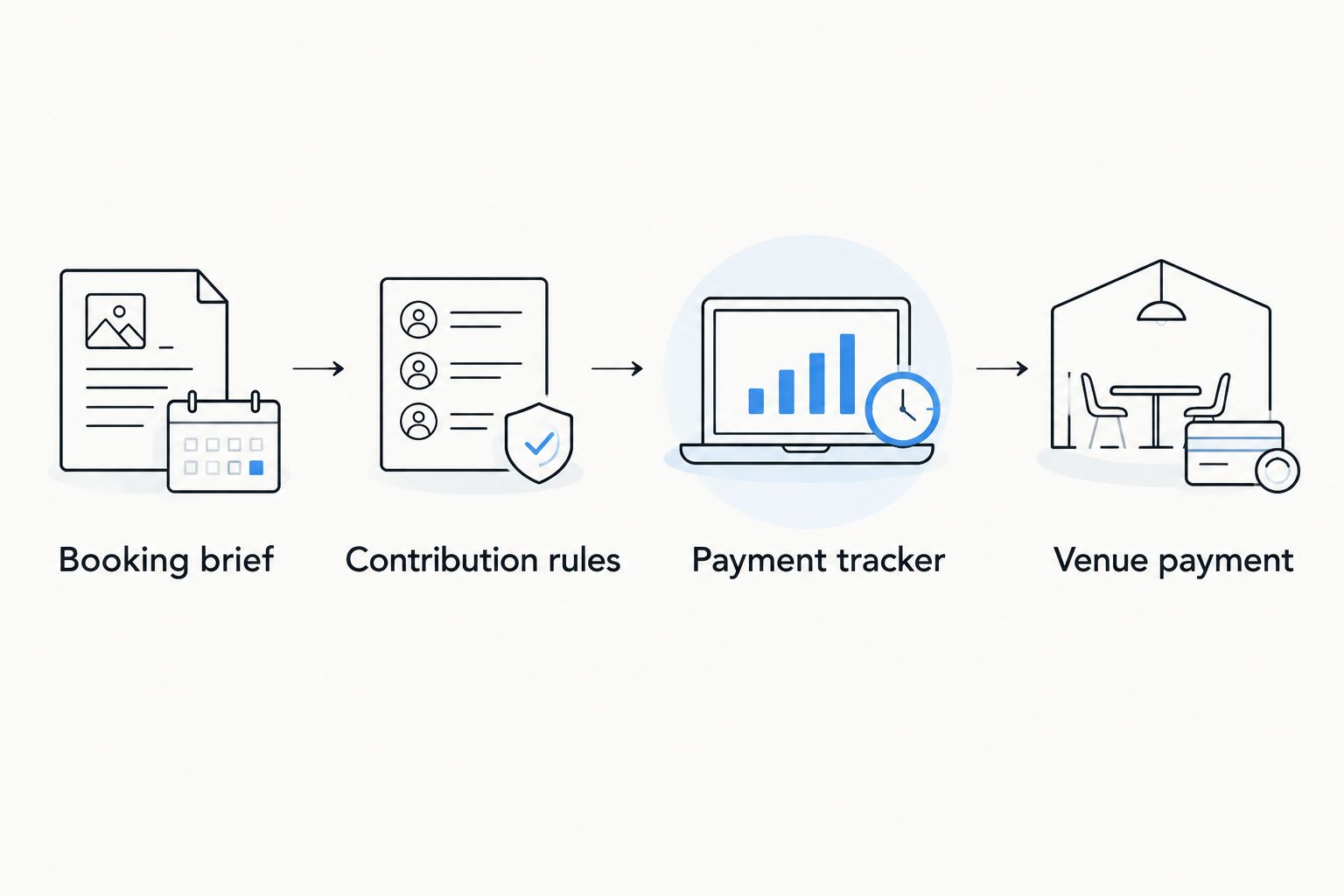
The sequence is Booking brief, Contribution rules, Payment tracker, then Venue payment. Keep that order: the tracker cannot settle a disagreement about what people agreed to pay for.
Send clear payment instructions
- Send each payer their agreed contribution privately, alongside the collection deadline and the payment details you have checked.
- Specify a recognisable transfer reference. Ask the payer to identify themselves consistently, especially if their bank account name differs from the attendee name.
- Ask each payer to tell you when they have sent the transfer and who it covers. Treat that message as a notification, not proof that funds have arrived.
- Check the receiving account before updating Received. A screenshot or a message saying payment is complete does not replace your own receipt check.
- Send a brief acknowledgement once you have matched the transfer. Give any unresolved payment query its own private conversation rather than burying it in the main chat.
Expected result: payers have a clear action to complete, and your tracker reflects received money rather than promises.
For a 2026 group event, include the event name in reminders so people do not confuse this collection with another outing. Repeat the same instructions rather than introducing a new account or payment reference midway through the process.
Venue payment and final reconciliation
Check the collection
- Match every received transfer to a payer. Investigate unidentified transfers before asking anyone to send money again.
- Compare the collected total with the agreed contribution total. Review partial payments, covered guests and any approved exceptions.
- Resolve outstanding contributions directly with the relevant payer. If the collection is incomplete, decide whether to proceed under an explicitly agreed arrangement or seek clarification about the booking.
- Check that the attendee list still matches the booking brief. A payment change and a headcount change are separate updates.
Expected result: the organiser knows what has been collected and which exceptions require a decision. No one is silently expected to cover the gap.
Record the venue payment
- Follow the payment instructions supplied for the booking. Do not substitute several individual payments unless that approach has been agreed with the venue.
- Save the payment acknowledgement and booking confirmation separately. Check the event details on the confirmation against your booking brief.
- Record the venue payment in your summary without marking unresolved attendee contributions as settled.
- Send the confirmed event details to the group. Keep payment administration separate from practical information about attending.
Expected result: you have evidence of the venue payment, the booking status and each payer’s contribution. Those records answer different questions.
A contribution tracker is useful for organising an activity-bar visit, but it is not a booking system. Confirm the reservation through the venue’s process rather than treating your spreadsheet as confirmation.
Variant: collect reimbursements after paying
Paying first uses the same tracker, but reverses the collection sequence. Use reimbursement only when the organiser agrees to advance the payment. Make that agreement explicit before committing money.
- Confirm the booking details and contribution rules with the group.
- Make the venue payment using the agreed instructions, then retain the acknowledgement.
- Record what the organiser actually paid and allocate the agreed attendee contributions against that payment.
- Send reimbursement instructions with a group deadline. Track incoming transfers against each payer’s row.
- Close the collection only after checking received transfers and resolving any remaining contributions.
Expected result: the organiser can reconcile reimbursements against an actual payment rather than an estimate.
For your 2026 birthday or team outing, keep any personal purchases outside this reimbursement record unless they were part of the agreed shared contribution. A later purchase should not quietly change what attendees originally approved.
If an employer or society covers part of the outing, record that contribution separately. Confirm who is authorised to approve or make that payment; do not treat an expected organisational contribution as money already received.
Troubleshooting
A transfer has no recognisable reference
Compare the received transfer with the payer’s message and ask for their sending name and transfer time privately. Mark the transfer as unmatched until you identify it. Do not request a replacement payment while the original transfer remains unresolved.
Someone says they have paid, but nothing has arrived
Keep the tracker marked as awaiting receipt and ask the payer to check the transaction status in their own account. Confirm that they used the payment details you supplied. Update the record only when the transfer reaches the receiving account.
Someone drops out after contributing
Check the booking’s change and cancellation terms before promising money back. Then apply the group’s agreed withdrawal arrangement and record any approved adjustment. An attendee leaving the chat is not confirmation that the venue booking has changed.
A late attendee wants to join
Check with the venue before assuming the existing booking covers another person. Agree any revised contributions with the affected payers before collecting more money. Keep the previous calculation so you can explain what changed.
The collected total does not match the tracker
Check for duplicate entries, partial transfers, payments covering several attendees and rounding differences. Reconcile against actual received transactions rather than chat acknowledgements. Record any final adjustment openly instead of leaving the organiser to absorb an unexplained difference.
Customise your workflow
Keep payment tracking small enough to use. A birthday organiser needs payer names and covered guests; a work organiser also needs a clear record of any employer contribution. Extra columns are useful only when they answer a real question.
For recurring 2026 socials, reuse the tracker headings but start a fresh record for each event. Do not carry an unsettled contribution into a new outing without identifying it separately and getting agreement from the payer.
Once the reservation is confirmed, move from collecting money to coordinating attendance. The guide to adding your booking to Google Calendar covers the adjacent calendar workflow. A shared event helps communicate the plan, but it does not replace booking confirmation or your payment record.
FAQ
Can everyone pay separately for a 1st Base group booking?
Confirm separate venue payments directly with 1st Base before organising them. Collecting contributions between attendees is a separate arrangement and does not establish how the venue accepts payment.
What is the best way to split payment for a group booking?
Collect agreed contributions before paying if the organiser does not want to advance everyone’s share. Use a payer tracker and confirm the venue’s payment instructions first.
Should I divide the booking contribution equally?
Use an equal split when everyone agrees they are covering the same shared elements. Record different contributions explicitly when someone covers a guest or pays for different agreed elements.
How do I track a payment that covers several people?
Record one payer row and list every attendee that transfer covers. Keep the payer count separate from the attendee count.
Does sending my share mean the booking is confirmed?
No, sending your share to the organiser does not confirm the venue booking. The organiser must complete the venue’s booking process and check the confirmation.
What happens if someone cancels after paying?
Check the venue’s applicable terms before promising a refund or changing the reservation. Then apply the withdrawal arrangement agreed within your group and record any adjustment.
Do I need a payment-splitting app for a 2026 group outing?
No, a spreadsheet or written tracker can record agreed contributions and received transfers. Use a payment method your group agrees on and verify receipts in the receiving account.
One last thing
Count people and payments separately. A transfer can cover several attendees, while an attendee can contribute through several transfers. Before you close the tracker, reconcile the attendee list with the booking and the received money with the contribution record—not with each other.