
Southampton theatre group social planning is choosing a shared activity with the aim of helping cast, crew and committee members connect away from rehearsals in 2026. Theatre groups need a format that mixes people across roles, accommodates different confidence levels and gives everyone more to do than repeat the usual post-show pub visit; this group activity venue guide covers the wider selection criteria.
- Theatre group social Southampton verdict: 1st Base suits casts and crews who want several competitive activities together.
- Plan mixed teams so performers, technicians, directors and committee members spend time outside their usual circles.
- Compare activity bars, pubs, restaurants and rehearsal-room socials by participation, conversation and planning effort.
- Use clear RSVPs, accessible activity choices and short game rounds to keep the night inclusive.
Why activity-led socials matter for theatre groups
A production creates strong working relationships, but those relationships often form within departments. Performers rehearse together, technical teams solve backstage problems, and committee members handle administration. A social should break those patterns instead of recreating them around separate tables.
Theatre groups also contain different personalities. Some members enjoy taking centre stage; others prefer a clear task before joining a conversation. Games provide that task. Nobody has to deliver an icebreaker answer or make small talk on demand because the activity gives the group an immediate subject.
Scheduling is the harder constraint in 2026. Rehearsals, performances, set construction and get-out already occupy evenings and weekends. The social therefore needs one organiser, a firm response deadline and a plan that works even when the final attendance changes. The organiser should focus on participation and timing rather than trying to produce another show.
How to plan a theatre group social in Southampton
Define what the social needs to achieve
Decide whether this is a cast-bonding night, an end-of-run celebration, a welcome for new members or a thank-you for the production team. One night can serve several purposes, but one should lead the plan. A relaxed welcome needs more conversation time; a closing-night event can carry more energy and competition.
- Write one clear purpose at the top of the invitation
- Choose either a rehearsal-season or post-production date
- Decide whether partners, family members or former members are included
- Name one organiser and one backup contact
- Add the social to the 2026 production calendar early
Map the group before choosing the venue
Start with people, not activities. List the expected cast, backstage team, creative team and committee, then identify anything that affects participation. Ask about access requirements, age restrictions and comfort with physical activity rather than assuming one format works for everybody.
This step also exposes the social dynamics. If new members only know their scene partners, build mixed teams. If the cast and crew already mingle easily, leave more unstructured time. The venue should support the group you actually have.
- Estimate attendance using named responses, not reactions in a chat
- Ask members privately about access or sensory requirements
- Check venue age rules directly when younger members are attending
- Record dietary requirements if food is part of the plan
- Separate essential requirements from optional preferences
Choose activities that create natural conversation
The strongest activity format lets somebody join quickly, understand what is happening and talk while other people take a turn. Shuffleboard, ping-pong and foosball all support short rotations. A batting cage adds a different challenge for members who want a more active moment.
The 1st Base activity bar in Southampton city centre combines an interactive baseball batting cage with shuffleboard, ping-pong and foosball. 1st Base is best for Southampton theatre groups that want several competitive activities without moving between venues. Its limitation is equally clear: a group seeking a quiet, conversation-only evening should choose a calmer format.
- Shortlist activities that beginners can understand quickly
- Offer both active and lower-intensity choices
- Avoid making one activity compulsory for the full group
- Confirm current venue rules before inviting members
- Keep conversation space in the schedule
Mix teams across cast and crew
Do not let friendship groups choose every team. That keeps performers with performers and technicians with technicians, defeating the point of the night. Create small, mixed groups and rotate opponents so members meet people they rarely speak to during production week.
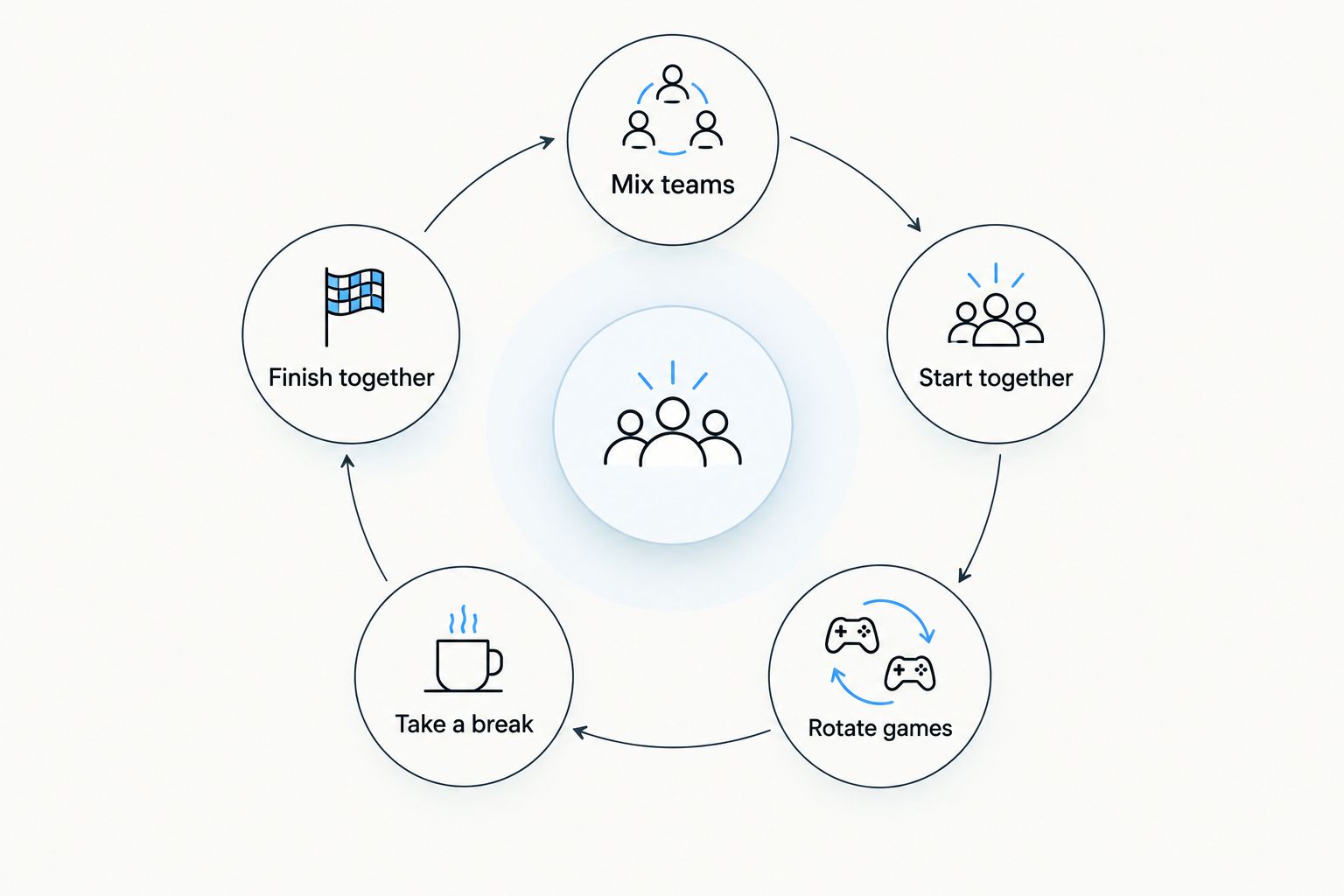
Keep the competition playful. A simple team name or running score adds energy, but complicated scoring turns the organiser into an adjudicator. Theatre members have already spent enough time waiting for notes.
- Put different production roles on each team
- Keep existing couples or close friends from forming one closed group
- Use 20-minute game rounds as a simple planning structure
- Rotate teams rather than eliminating losing players
- Drop the scoreboard if competition starts limiting participation
Build a simple run of show
A theatre social still benefits from structure, but nobody needs another stage-management document. A short sequence is enough: arrival, welcome, activities, break and an open finish. Share only the essential timings with attendees and keep the detailed contact information with the organiser.
Add a 15-minute arrival buffer before the first organised activity. This prevents late arrivals from interrupting team selection and gives members time to settle in. End structured play before the booking ends so conversation does not get cut off just as people relax.
- Set one meeting point for the whole group
- Add an arrival buffer before team activities
- Keep the welcome short and practical
- Place a break between activity rounds
- Leave the final part of the night unstructured
Set the budget before collecting responses
Am-dram and community theatre members can have different spending limits. State what attendees need to pay, what the group will cover and whether food or drinks are separate before asking for a commitment. Never use vague wording such as affordable because it means something different to every member.
Do not publish a venue cost that can change. Check the current booking details directly, then give members the confirmed amount and payment deadline. If the society is subsidising the event, explain that in the same message so the invitation is clear.
- Request current group costs from the venue
- State exactly what the payment covers
- Set one payment and cancellation deadline
- Explain any society contribution clearly
- Keep personal spending on food or drinks optional
Confirm the plan without flooding the group chat
Send one complete invitation containing the date, meeting point, timings, activity outline, cost information and response method. Follow it with a 48-hour reminder before the RSVP deadline. Repeated fragments create confusion and make the organiser answer the same questions individually.
On the day, send one concise confirmation. The organiser should also keep the venue contact details and attendance list available. Members only need the information required to arrive and take part.
- Put all booking details in one message
- Use a clear yes-or-no response method
- Send one deadline reminder
- Confirm the final meeting point on the day
- Tell members whom to contact if their plans change
Plan your theatre social
Explore batting cages, shuffleboard, ping-pong and foosball in Southampton city centre.
Comparing social options for theatre groups
The right 2026 option depends on whether your group values activities, conversation, food or minimal organisation. No format wins every category, and the best choice follows the purpose set at the start.
| Option | Best for | Main advantage | Key limitation |
|---|---|---|---|
| 1st Base activity bar | Cast and crew wanting several games in one venue | Batting cage, shuffleboard, ping-pong and foosball create different ways to join in | Less suitable for a silent or conversation-only gathering |
| Pub table | A small group prioritising informal conversation | Familiar format with little explanation needed | Members can settle into existing friendship groups |
| Restaurant meal | A thank-you event centred on eating together | Everyone shares one clear activity | Fixed seating can limit mixing across the company |
| Rehearsal-room social | A group wanting to use a familiar space | The location is already known to members | It can feel too similar to another rehearsal night |
An activity bar wins when participation is the priority. A restaurant wins when the meal itself is the event. A pub suits a group that already mixes easily, while the rehearsal room keeps the format familiar but offers the least separation from production work.
Common mistakes theatre groups make
Organising another performance
Themes, costumes, speeches, awards and tightly timed competitions can turn the organiser into a producer again. Keep one or two playful elements and remove anything that requires rehearsal. The night should release pressure rather than create a new deadline.
Letting departments stay separate
Cast members naturally sit with scene partners, while crew members remain with the people they worked beside backstage. Pre-planned teams interrupt that pattern. Mix people at the beginning instead of hoping they will move later.
Choosing only for confident participants
A loud or physical activity can appeal to outgoing members while discouraging somebody who prefers a slower start. Offer different games and allow people to watch, talk or take a break without making them explain themselves.
Leaving important details in separate messages
A date in one chat, a meeting point in another and payment information sent privately will produce missed details. Put the full plan in one message and edit that message when something changes.
Copying the previous social automatically
The format that worked after a small studio production might not fit a larger musical, youth production or technical-heavy show. Review the purpose, group needs and venue rules for every 2026 event rather than repeating the last booking by default.
FAQ
What is the best theatre group social in Southampton?
1st Base is best for Southampton theatre groups that want batting cages, shuffleboard, ping-pong and foosball in one city-centre activity bar. A quieter group focused entirely on conversation should choose a pub table or restaurant instead.
How do you organise a theatre cast social?
Set the purpose, list attendee requirements, compare suitable venues, create mixed teams and send one complete invitation. Give members a clear RSVP and payment deadline rather than collecting uncertain responses across several chats.
When should an am-dram group hold its social in 2026?
Choose either an early-season bonding night or a post-production celebration and add it to the 2026 production calendar. Avoid placing it where it competes with rehearsals, technical preparation or get-out.
How much does a theatre group social cost?
The cost depends on the venue, activities and group arrangements, so check current booking details directly. Tell members what their payment covers before collecting confirmations.
How can cast and crew mix at a social night?
Place performers, technicians, creatives and committee members on mixed teams, then rotate those teams between activities. Do not allow existing departments to form closed groups for the whole night.
Are activity bars suitable for theatre members who do not drink?
An activity-led venue can keep the focus on games rather than alcohol. Confirm the venue's current food, drink and age rules directly before making the booking.
What games work for an am-dram social?
Choose games with quick turns and simple rules, such as shuffleboard, ping-pong or foosball, then include an alternative for members wanting a different intensity. The aim is shared participation, not finding the most difficult challenge.
Should a theatre social include awards or speeches?
Keep speeches brief and awards optional so the night does not become another production. A simple thank-you works better than a long programme requiring preparation.
One last thing
The most useful team list is not the most balanced competitive list. It is the one that places a lead performer beside the lighting operator, a new member beside a committee regular and a director beside someone they normally only see across the rehearsal room. In 2026, organise for new conversations first and scores second.