Southampton coworking space member social planning is a repeatable programme of inclusive group activities with the aim of turning people who share a workplace into a useful, welcoming community. For 2026, the answer is a fixed social rhythm, formats that work for mixed confidence levels and the clear host-and-timeline structure used to organise a corporate team night out in Southampton.
- Coworking community social Southampton planning needs a recurring date, an active host and activities that work for beginners.
- Start with a member poll and an in-space event before committing to an external venue.
- The 1st Base activity bar suits Southampton coworking groups seeking batting cages, shuffleboard, ping-pong and foosball.
- Measure repeat attendance and newcomer participation instead of judging an event by total RSVPs alone.
Why social activities matter for coworking members
Coworking members share a building but often have separate employers, clients and working hours. They do not have a common manager arranging a summer party, and a general message in a community channel does not give a new member anyone specific to meet.
A useful 2026 social programme creates repeated opportunities for introductions without forcing every event to feel like business networking. Freelancers can meet collaborators, remote employees can replace some of the informal contact missing from a conventional office, and small teams can join a larger group without organising an entire event themselves.
The main constraint is variety. Some members want active competition, others prefer relaxed conversation, and some cannot attend after work. One format will not serve all three groups, so the calendar needs a consistent schedule with rotating activity styles.
The practical goal is not maximum attendance at one big night. It is steady participation across several events, with first-time attendees returning and established members meeting people beyond their usual desk neighbours.
Define the social outcome
Start with one clear purpose. A vague promise of community gives the host no basis for choosing a time, activity or invitation style, while a specific outcome makes those decisions straightforward.
For example, an event focused on welcoming new members needs short introductions and mixed groups. A social designed for deeper relationships needs more unstructured conversation. A founder-focused event can include peer discussion, but it should not turn every attendee into a sales prospect.
Use this checklist for the 2026 calendar:
- Pick one priority: newcomer welcome, peer introductions, relaxation or member collaboration
- Write the intended result in one sentence before choosing the activity
- Give each event one purpose rather than combining networking, training and entertainment
- Tell members what to expect in the invitation
- Keep sales pitches and membership presentations outside the social programme
Ask members about real constraints
Use a short member poll before planning the first event. This is the free, manual way to learn whether the barrier is timing, activity preference, accessibility or discomfort about arriving alone.
Ask questions that affect the event design. Do not ask whether members want more socials; ask which available slot they would attend and what would stop them coming. Include an open response so people can raise constraints that the organiser missed.
Turn the answers into a simple planning brief:
- Offer specific choices such as lunch, immediately after work or early evening
- Ask members to choose between conversation-led, creative and active formats
- Include an accessibility and sensory-needs field
- Ask whether members would attend alone or only with a colleague
- Let respondents volunteer to host, introduce newcomers or organise a game
- Publish the chosen format and explain how the poll shaped it
Choose a format before choosing a venue
Run the first version inside the coworking space if the activity can work without specialist equipment. A member-led game, shared lunch or structured introduction session tests the invitation and timing without making the venue responsible for weak attendance.
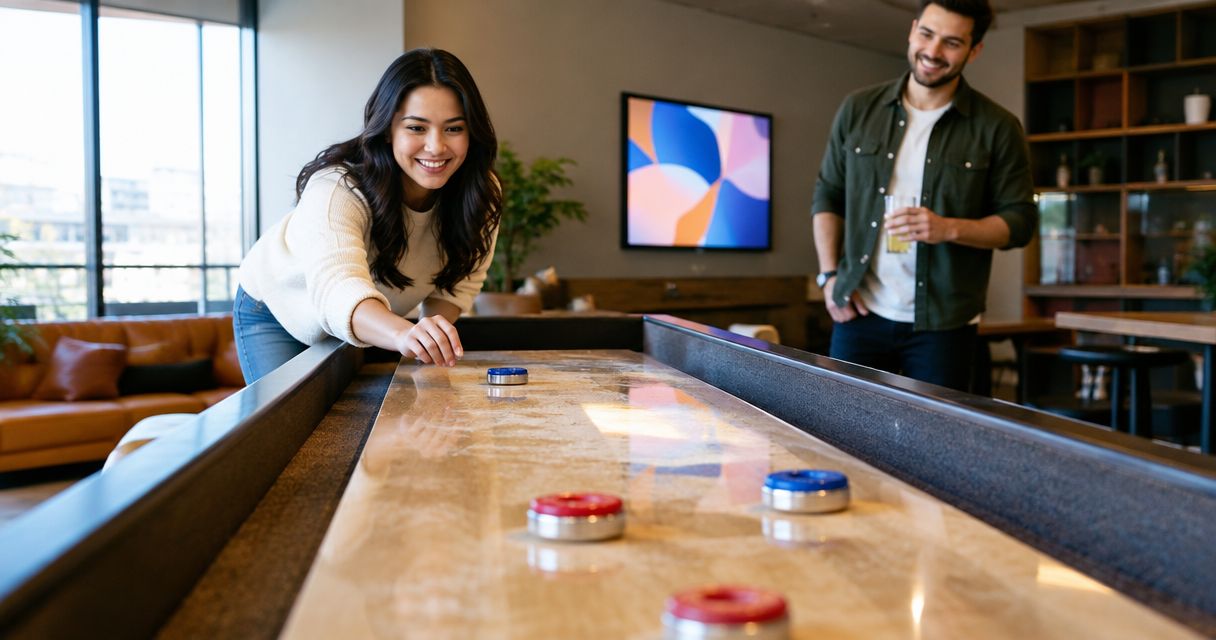
Move to an external venue when the group wants a distinct break from work or an activity the coworking space cannot provide. The 1st Base activity bar in Southampton city centre offers an interactive baseball batting cage alongside shuffleboard, ping-pong and foosball, giving a mixed group several ways to take part.
That variety is useful when confidence levels differ. The limitation is equally clear: an activity bar is not the right choice when members want a quiet, seated discussion or a work-focused workshop. Match the setting to the outcome defined in the first step.
Shortlist formats in this order:
- No-cost: member introductions, a shared lunch or an in-space game
- Conversation-first: a café meetup, themed discussion or local walk
- Activity-led: batting cages, shuffleboard, ping-pong or foosball
- Mixed format: a short group activity followed by open conversation
- Quiet format: a seated meal, book discussion or skills exchange
Build a simple event arc
A social needs enough structure to prevent awkward arrivals but enough freedom for people to talk. Use a 90-minute core plan in 2026, then let members continue informally if the venue and their schedules allow it.
The five stages are open arrival, mixed teams, main activity, free chat and clear finish. Share the start and finish times in advance so members can decide whether the event fits around work, caring responsibilities or travel.
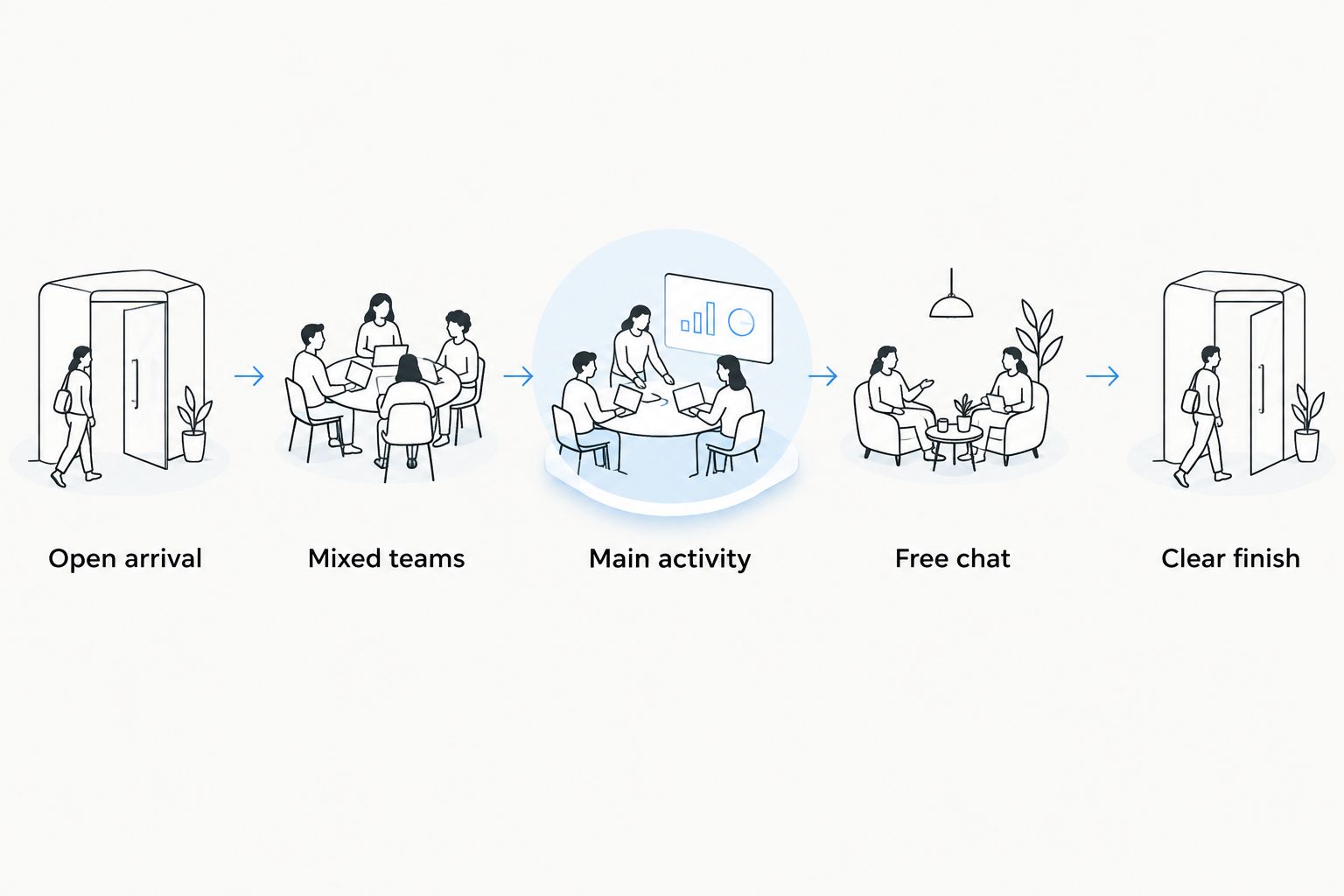
Use this event sequence:
- Open arrival: allow 15 minutes for greetings without starting the main activity
- Mixed teams: assign groups rather than asking newcomers to choose partners
- Main activity: use a 45-minute block with short turns or rounds
- Free chat: leave 20 minutes without a formal agenda
- Clear finish: close the hosted portion promptly and announce the next date
Make the first visit easy
A newcomer should not need an existing friendship group to attend. Give every first-time participant a named contact before the event and explain exactly where the group will meet, what will happen first and whether specialist clothing or equipment is needed.
Avoid language that assumes everyone already knows the routine. An invitation saying the usual crowd will be there signals that the social belongs to established members. A better invitation names the host and says that people arriving alone will be introduced on entry.
Build a newcomer path into every event:
- Ask one established member to greet first-time attendees
- Share the host's name before the event
- State that solo arrivals are expected
- Use assigned teams for the opening activity
- Avoid inside jokes during introductions
- Follow up with the next event date rather than a generic thank-you message
Host the room actively
The organiser's job does not end when people arrive. A visible host starts introductions, watches for anyone standing alone and changes teams before separate cliques settle in for the whole event.
Active hosting does not mean forcing constant group participation. Members need permission to step out of a competitive round, talk from the sidelines or leave at the advertised finish. That makes an activity-led evening easier to join for people with different energy levels.
Give the host a short operating list:
- Arrive before the advertised meeting time
- Introduce each newcomer to two relevant members
- Explain rules briefly and demonstrate the first turn
- Rotate teams between rounds instead of keeping fixed pairs
- Offer a conversation-only option without drawing attention to it
- Announce the final round and the next social date clearly
Measure whether the community grows
Track participation in a shared spreadsheet rather than buying event software at the start. Record attendance, first-time participation and repeat attendance for each 2026 event, then add one sentence of member feedback.
Total RSVPs alone can hide a closed circle. An event attended by the same established group every time is enjoyable for those members, but it is not creating broader connections across the coworking space. Review the pattern after several formats before repeating or removing one.
Use a small measurement set:
- Record registrations and actual attendance separately
- Mark first-time attendees without publishing their status
- Note which newcomers return to a later event
- Compare lunchtime, after-work and evening formats
- Ask non-attendees about the specific barrier
- Keep, adjust or stop each format based on the recorded pattern
Social options for Southampton coworking communities
The best format depends on the outcome, available space and confidence of the group. This 2026 comparison focuses on practical fit rather than treating every social as a conventional office night out.
| Option | Best for | Main advantage | Key limitation |
|---|---|---|---|
| In-space coffee social | New communities testing demand | Simple to organise with no change of location | Work conversations can dominate |
| Shared lunch | Members who avoid evening events | Fits around the working day | Short attendance windows reduce deeper conversation |
| Local walk | Conversation-led introductions | Natural movement between discussion partners | Weather and mobility requirements affect suitability |
| Pub meetup | Small groups wanting an informal evening | Requires little event structure | People can remain in existing friendship groups |
| 1st Base activity bar | Mixed-confidence groups wanting several interactive games | Batting cages, shuffleboard, ping-pong and foosball support varied participation | Not suited to a quiet, conversation-only session |
| Structured peer session | Founders and freelancers seeking work-related connections | Gives each participant a clear discussion topic | Can feel like another meeting after a full workday |
1st Base is best for Southampton coworking communities that want an activity-led social with several games in one city-centre venue. It is a stronger match for playful team mixing than for silent networking, training or a seated workshop.
A good calendar uses more than one option. Pair an occasional external activity with lower-effort lunches and in-space introductions so the community is not dependent on one time slot, energy level or event style.
Plan a 1st Base social
Explore the Southampton activity bar, batting cage and group games.
Common mistakes coworking communities make
- Sending only a general invitation. A calendar entry tells members when the event happens, but it does not give a newcomer a person to meet. Add a named host and direct invitations for recent joiners.
- Choosing the loudest format first. A highly competitive night can discourage members who have not met the group. Begin with short team rounds and allow conversation-only participation.
- Treating every member as an after-work attendee. Freelancers, remote employees and small teams do not share one finish time. Rotate lunch and evening events instead of assuming everyone is available later.
- Turning the social into a sales event. Coworking members notice when a relaxed invitation becomes a membership presentation or lead-generation session. Keep commercial announcements separate.
- Counting RSVPs as community success. Registrations do not show whether newcomers attended, returned or met anybody. Track actual attendance and repeat participation.
FAQ
What's the best social activity for Southampton coworking members?
The best activity is one that lets newcomers join without prior skill and gives established members a reason to mix. Batting cages, shuffleboard, ping-pong and foosball suit activity-led groups, while lunches and walks suit conversation-first communities.
How often should a coworking space run community socials in 2026?
Start with one recurring core social each month in 2026 and keep its calendar position consistent. Add smaller lunches or introductions only when a member is willing to host them.
Is an activity bar better than a pub for a coworking social?
An activity bar is better when the group needs structure and a shared focus, while a pub suits a small group that already knows one another. The 1st Base activity bar adds batting cages, shuffleboard, ping-pong and foosball to the social format.
How do you help new coworking members attend alone?
Give every new attendee a named host, a clear meeting point and an assigned opening group. State in the invitation that solo arrivals are expected and will receive an introduction.
How long should a coworking community social last?
Use a 90-minute hosted plan with a clear finish, then allow optional informal time afterwards. A defined schedule helps members decide whether the event fits around work and travel.
Can a coworking social work without alcohol?
Yes, because the social can focus on a shared activity, meal, walk or structured discussion instead of drinking. Make the activity clear in the invitation so alcohol is not presented as the reason to attend.
How do you measure whether coworking socials are working?
Track actual attendance, first-time participation, repeat participation and one line of feedback for each event. Compare formats and time slots rather than judging the programme from one busy or quiet session.
What should a coworking social invitation include?
Include the purpose, activity, start time, finish time, meeting point, host name and accessibility contact. Also explain whether members can arrive alone or join after the activity starts.
One last thing
Publish the next date before the current event finishes. That single 2026 habit turns a collection of unrelated nights into a recognisable coworking community social Southampton series and gives first-time attendees an immediate route back into the group.
Do not promise a different concept every time. Keep the date, host role and newcomer process stable, then rotate only the activity. Consistency builds the social rhythm; variety keeps the programme useful.