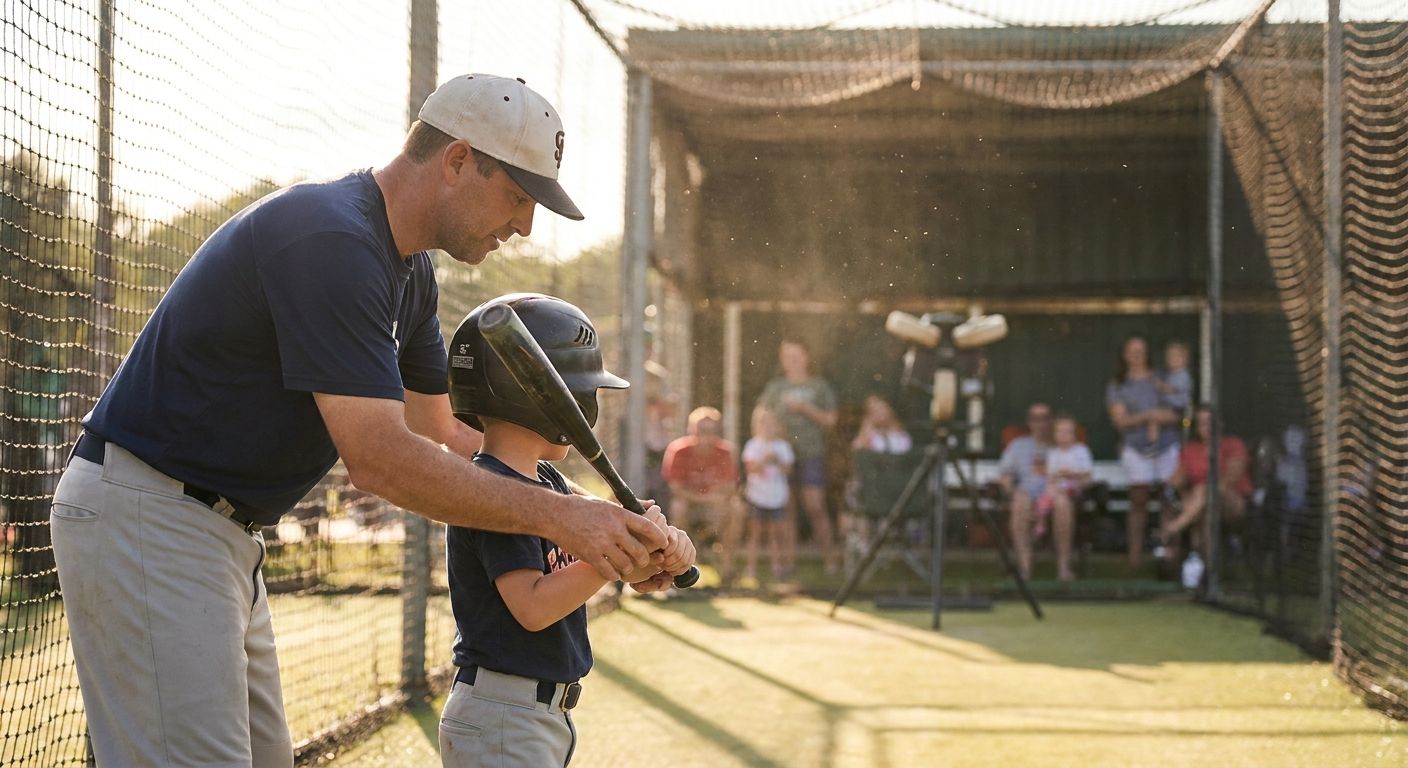
Kids don't need a scout's eye or a college scholarship to enjoy a batting cage — they need the right setup, patience, and someone standing beside them who knows what to fix first. This guide breaks down exactly how to teach kids batting cage basics from first swing to consistent contact.
- Start kids on the slowest pitch speed available and move up only after five clean contacts in a row.
- A shorter, lighter bat beats a bigger one for kids learning to teach kids batting cage fundamentals.
- 1st Base in Southampton runs beginner-friendly cage sessions built for ages 8 to 80.
- Most swing-and-miss problems trace back to stance or timing, not strength — fix the feet first.
Why this matters
A bad first session at a batting cage can put a kid off baseball for good. Swing too fast a pitch at a nervous 9-year-old and you'll get flinching, not learning. Get the pitch speed, stance, and encouragement right in the first ten minutes and most kids are making contact by the end of the visit.
The goal isn't a perfect swing on day one. It's building enough confidence that the kid wants to come back. That's the difference between a one-off outing and a kid who asks for a batting cage session every birthday.
What you'll need
- A batting cage with adjustable pitch speed — non-negotiable for kids under 12
- A bat sized to the child, not a hand-me-down adult bat
- Batting gloves if the venue has them, or a snug pair of trainers with grip
- 20-30 minutes of uninterrupted time — rushing kills confidence faster than a bad swing
- One adult focused entirely on coaching, not scrolling on a phone between turns
- Water on hand — kids overheat fast when they're concentrating
The steps
1. Pick the slowest pitch speed on the machine
Every cage worth using lets you dial down the speed. Start as low as the machine goes, even if it looks too easy. Confidence comes from contact, not challenge, and a kid who whiffs ten pitches in a row will want to leave.
Move the speed up only after five clean, solid hits in a row. That's the benchmark — not a set number of minutes, not what a sibling managed last visit.
Common mistake: parents nudge the speed up too early because the slow pitch "looks babyish." Resist it. A kid hitting the ball at the slowest setting learns more in 2026 than one missing every pitch at a faster one.
2. Set the stance before the first swing
Feet shoulder-width apart, knees slightly bent, weight balanced rather than leaning back. Have the kid hold the bat up near their shoulder, not down at their waist — a low bat means a late swing.
Stand behind them and physically walk their feet into position if needed. Verbal instructions ("widen your stance") often don't land with younger kids the way a hands-on adjustment does.
Common mistake: kids copy what they've seen on TV — an exaggerated crouch or a bat held too far from the body. Reset the stance every few pitches until it sticks.
3. Teach the eyes-on-the-ball rule before the hands-on-the-bat rule
Most missed swings happen because the kid is watching their own bat, not the incoming ball. Have them track the pitching arm or wheel from release to the plate for the first few rounds without swinging at all.
This sounds slow, but it's the single biggest fix for inconsistent contact. A kid who watches the ball all the way to the bat connects far more often than one swinging on instinct.
Common mistake: rushing straight to swinging. Give the tracking drill at least five pitches before a bat ever leaves the shoulder.
4. Break the swing into three checkpoints
Don't overload a kid with a full mechanical breakdown. Give them three cues: load (weight back), stride (small step forward), swing (hips turn first, hands follow). Say all three out loud before each pitch for the first round.
Drop the verbal cues once the sequence starts happening on its own — usually within 10-15 pitches for most kids aged 8 and up.
Common mistake: correcting too many things at once. Fix one checkpoint per round, not all three simultaneously.
5. Celebrate contact, not just hits
A foul tip, a weak dribble, a ball that barely clears the plate — all of it counts as a win at this stage. Cheer it the same way you'd cheer a line drive. Kids read adult reactions closely and will chase whatever gets the biggest response.
This matters more for younger kids and first-timers than for anyone chasing a specific technique. Confidence compounds faster than mechanics at this age.
6. Rotate turns to keep attention sharp
Kids lose focus after roughly 8-10 pitches in a row. Rotate between kids, or between hitting and tracking drills, rather than running one long uninterrupted turn. A beginner-friendly cage session built for parties or family outings usually structures turns this way already.
Common mistake: letting one kid dominate the cage while others wait and disengage. Short, frequent turns beat long, rare ones.
7. End on a good swing, not the clock
If time's nearly up and the last few swings have been strong, stop there. Ending on a miss because the session ran out leaves a worse impression than ending five minutes early on solid contact.
Troubleshooting
- Kid keeps closing their eyes before contact. Slow the pitch speed further and go back to the tracking drill from step three before reintroducing swings.
- Bat feels too heavy, swing looks sluggish. Check the bat size against the child's height and grip strength — a bat that's too long or heavy wrecks timing regardless of technique.
- Kid is swinging late every time. The stride is usually too big or too slow. Shrink the front-foot step to a small tap rather than a full stride forward.
- Frustration builds after a few misses. Drop the pitch speed one level and switch to five tracking-only pitches before swinging again. Reset the win rate before pushing forward.
- Kid loses interest halfway through. Shorten turns to 5-6 pitches and rotate faster, or switch activities entirely for ten minutes before coming back.
- Grip keeps sliding. Check hand position — bottom hand should sit right above the knob, not choked up too high, and gloves help more than most parents expect.
Tools and resources
For families in Southampton planning a first visit, a few pages are worth reading before you book:
- How to prepare for your first batting cage session in Southampton covers what to expect on arrival
- Best batting cages near Southampton for group sessions if you're bringing more than one family
- Best half-term activities for kids in Southampton for planning around school holidays in 2026
Book a beginner-friendly cage session
Adjustable pitch speeds make it easy to teach kids batting cage basics from scratch.
What to do next
Once a kid is making consistent contact at the slowest speed, the next step is building a routine — regular short sessions rather than one long annual outing. Kids who visit a batting cage a handful of times across 2026 progress faster than kids who go once and don't return for a year.
FAQ
What age can kids start using a batting cage?
Most venues welcome kids from around age 8, provided the pitch speed is adjustable down to a beginner setting. Younger kids can still enjoy tee-style setups if the cage offers them.
How do I teach kids batting cage basics if I've never played baseball myself?
Focus on stance, eye tracking, and slow pitch speed — none of it requires playing experience. Staff at most cages will also walk first-timers through the basics on arrival.
What size bat should a kid use in a batting cage?
A bat sized to the child's height and grip strength matters far more than bat weight or brand. An oversized bat slows the swing and throws off timing regardless of the pitch speed.
How long should a kid's first batting cage session last?
20-30 minutes is usually enough for a first visit, split into short rotating turns of 5-10 pitches. Longer sessions risk losing a young kid's attention before the swing mechanics settle in.
Is a batting cage safe for a nervous or younger kid?
Yes, as long as the pitch speed starts at the slowest setting and the kid tracks a few pitches before swinging. Cages built for beginners in Southampton and similar venues typically default to slower speeds for exactly this reason.
What's the biggest mistake parents make teaching kids to hit?
Pushing the pitch speed up too fast because the slow setting looks too easy. Confidence from repeated contact matters more than speed at the early stage.
Can a batting cage work for a birthday party with mixed ages?
Yes — adjustable speeds let younger and older kids rotate through the same cage at different settings. It's one of the more flexible group activities for a mixed-age birthday in 2026.
One last thing
The kids who improve fastest aren't the ones swinging hardest — they're the ones tracking the ball longest before the bat ever moves. Slow that part down before anything else and the rest of the swing tends to follow on its own.